
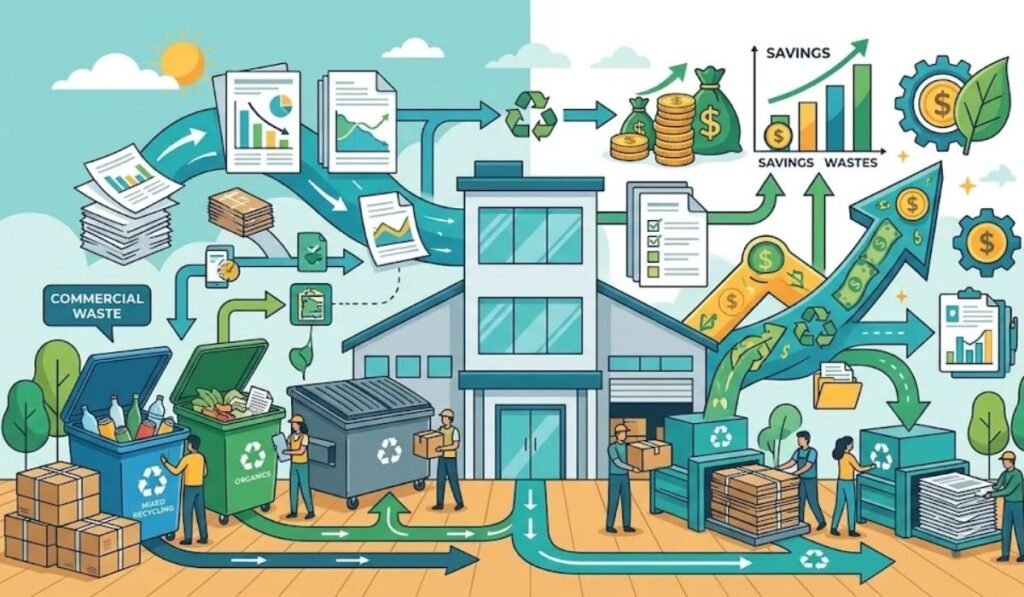

Commercial waste management is one of those costs that drifts without anyone really noticing. The invoice arrives every month, it gets paid, and unless the number jumps sharply, nobody actually looks at what’s in it. Give it a few years and a business can end up paying for bins that are too big, lifts it doesn’t need, and fees that were entirely avoidable from the start.
Most of the real savings come from changing how waste is sorted and collected, not from switching providers every twelve months, which rarely achieves as much as people hope. Here’s where the money tends to go, and what usually brings it back.
Where the Cost Comes From
Landfill levy. Every tonne of general waste sent to landfill in Victoria attracts a state levy, and it’s climbed steeply in recent years. The provider pays it at the tip and folds it into the price. The more waste that ends up in the general bin, the more levy gets paid, even when the bin size hasn’t changed at all.
Collection frequency. Plenty of businesses are paying for lifts on bins that are half full. A front lift bin collected twice a week when it’s only ever sitting at 60 per cent on collection day is costing a lift that simply isn’t needed.
Bin size. The opposite problem shows up just as often. A bin that overflows leads straight to extra lifts, side waste fees, or a loading dock that looks like a mess by Friday.
Contamination. Recycling bins cost less to service than general waste, since the material has value and avoids the levy. Once a recycling bin’s been contaminated with food, soft plastics or bagged rubbish, it can get charged as general waste or attract a contamination fee on top.
Contract terms. Automatic renewals, rise and fall clauses, minimum lift commitments, bin rental, all of it affects the final price, and most of it gets agreed once and never looked at again.
Start With a One-Week Check
Before talking to anyone about price, it’s worth spending a week looking in the bins just before they’re collected. How full is each one, what’s actually in it, a quick photo if it helps. It takes a few minutes a day, and it’s the information behind every other decision on this list.
Most businesses find one of two things when they actually look. Either a large share of the general waste bin is cardboard or recyclable packaging, or the bins are routinely being collected well before they’re full.
Get Cardboard Out of General Waste
For retailers, warehouses and anyone taking regular deliveries, cardboard is often the bulkiest thing sitting in the general waste bin. It takes up space, drives extra lifts, and gets charged at landfill rates the whole time. A separate cardboard bin, or a baler on larger sites, usually costs less per lift than general waste and frees up real room in the general bin. On some sites, that change alone is enough to drop a bin size or cut a collection day.
Match Bins and Collections to What You Produce
Commercial bins range from 240 litre wheelie bins and 660 or 1100 litre rear lift bins up to front lift bins of 1.5 to 4.5 cubic metres. A small office might be best served by two wheelie bins collected weekly. A busy restaurant or warehouse is often better off with one larger front lift bin collected less often than several smaller ones scattered around. The right answer comes down to volume and site access, which is exactly why the one-week check matters more than guessing.
Fix Contamination Where It Starts
Contamination is usually a setup problem rather than a people problem. Put recycling bins right next to general waste bins so nobody has to walk further to do the right thing. Label them with pictures of what actually goes in, not just words. Cover waste sorting in staff inductions, particularly in hospitality where turnover is high and habits reset constantly. These are small changes, but they’re often the difference between a recycling bin getting collected as recycling or not.
Separate Food Waste If You Produce a Lot of It
Food waste is heavy, and general waste pricing often factors in weight. Cafes, restaurants, aged care facilities and food manufacturers can cut general waste volume considerably by moving scraps into an organics collection instead, which keeps that material out of landfill altogether.
Read the Contract Before It Renews
Worth checking when the agreement actually ends, whether it renews automatically, how much notice is required, and what fees apply for changing bins or exiting early. Rise and fall clauses deserve particular attention, since they allow prices to climb during the term without much fanfare. Putting the renewal date in the calendar a few months ahead buys enough time to actually review it properly.
Ask for Reporting
A good provider can supply tonnage and diversion figures showing how much waste is going to landfill versus getting recycled. That data makes it possible to tell whether the changes are actually working, and it’s increasingly useful for businesses that report on sustainability to customers, landlords or head office.
Choosing Who Collects It
Price matters, but it’s only part of the picture. Worth looking for a provider that holds the right EPA licences for the waste being produced, has depots close enough to respond quickly when something goes wrong, and will actually review the service rather than just quoting for more bins. A commercial waste management partner that offers a site audit and regular diversion reporting will usually save more over the life of a contract than whoever’s offering the lowest rate on day one.
If only one thing happens this week, find the contract renewal date and put it in the calendar. Everything else on this list can get done well before it arrives.