
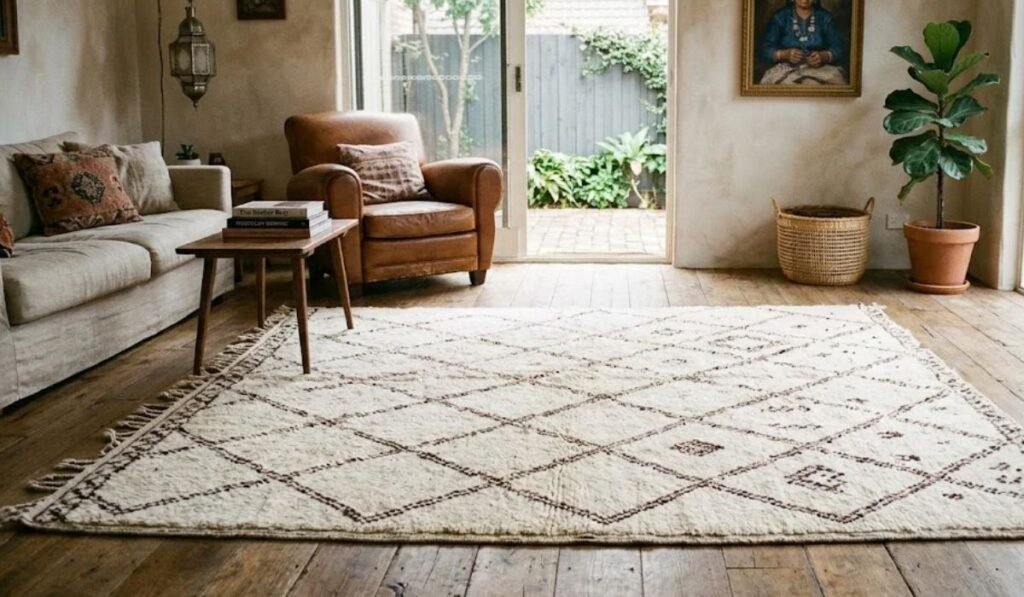

Few rugs are as instantly recognisable as a Moroccan one. The soft, ivory wool of a Beni Ourain, the bold diamond lattice, the irregular hand-drawn lines, these are pieces that found their way out of the Atlas Mountains and into design magazines the world over, and simply never left.
The appeal here isn’t a passing trend, and it’s worth being upfront about that. Moroccan rugs have been made in much the same way for generations, and understanding where they actually come from explains why they still work so well as designer rugs in contemporary Australian homes.
A Craft Rooted in the Atlas Mountains
Moroccan rugs originate with the Berber, or Amazigh, peoples of North Africa, who were weaving them by hand long before anyone outside the region called them fashionable. Traditionally made by women, each rug served a specific purpose: thick, high-pile pieces for warmth through cold mountain winters, flatter weaves suited to milder climates.
Because these rugs were made for use rather than for sale, the designs carried real personal meaning. Patterns, symbols and small irregularities recorded something of the weaver’s own life and surroundings, which is exactly why a genuinely traditional piece is never quite identical to another.
The wool itself carried part of that character too. Sheared from local sheep and often left undyed, it kept the natural lanolin that gives an authentic piece its soft sheen and its resilience underfoot. Woven on simple upright looms, these were slow, deliberate objects, made over weeks rather than knocked out in an afternoon.
The Styles You Will Recognise
Several distinct traditions sit under the Moroccan umbrella, and knowing them apart is worth the effort. Beni Ourain rugs are the best known, plush, undyed cream wool with a simple dark lattice, and endlessly versatile in almost any room.
Azilal rugs lean more colourful and expressive, often set on a natural ground with bright, spontaneous motifs. Boucherouite rugs are woven from recycled fabric offcuts, vivid and improvised, born out of genuine thrift long before upcycling had a name attached to it.
Beyond these, Boujaad rugs bring warmer reds and pinks in looser, more painterly compositions, while flatwoven Kilim pieces offer a low, hard-wearing alternative with no pile at all.
Knowing the difference matters, because the name tells a real story about the look, the texture and the tradition sitting behind a given piece. It’s part of what keeps them such enduring designer rugs decades on.
Why They Still Feel Modern
Moroccan designs have endured because they sit comfortably in almost any interior, not just the ones they were originally made for. The neutral palette and geometric simplicity of a Beni Ourain, in particular, work as easily in a pared-back contemporary room as they once did in a mountain home.
They also add what a lot of minimalist interiors are genuinely missing, texture, warmth and a sense of the handmade. A single Moroccan-style rug can soften a room full of hard surfaces and clean lines, which is exactly why designers reach for them so consistently. As designer rugs go, they’re unusually adaptable across styles that otherwise have little in common.
They carry a story too, which is increasingly what people actually want from the things they live with. A handmade piece with genuine heritage brings a depth to a room that a mass-produced design simply can’t replicate, and that quality doesn’t fade with the seasons the way a trend-led choice tends to.
Buying With an Eye for Authenticity
As with any admired style, there’s a real difference between a genuine handmade piece and a mass-produced imitation of the look, and that distinction is worth the money to get right. It matters most when paying for real, handmade designer rugs rather than a printed lookalike wearing the same pattern.
Worth asking how and where a rug was actually made, and whether it’s genuinely hand-woven. Origin isn’t a small detail here. A true Moroccan rug is made in Morocco, while a Moroccan-inspired design draws on the tradition without claiming to be from there. Both can be lovely in their own right, but they’re not the same thing, and a reputable seller will always be upfront about which one is in front of you.
It’s also worth feeling the weight and the pile in person before deciding. A genuine hand-knotted or hand-woven Moroccan piece has a density and a slight unevenness that a machine-made copy never quite manages to reproduce, and once that difference has been felt, it’s genuinely hard to unsee.
Bringing the Look Home
A Moroccan or Moroccan-inspired rug is one of the more straightforward ways to bring real warmth and character into a contemporary space. Letting it be the piece that adds texture, keeping the palette around it calm, and giving a high-pile design room to actually be appreciated underfoot tends to get the most out of it.
For anyone drawn to these designs, the sensible approach is the same as with any considered purchase: see a few in person, feel the wool, and ask directly about construction and origin before handing over any money. That’s ultimately what separates a rug worth keeping for decades from one that’s just following a trend.