
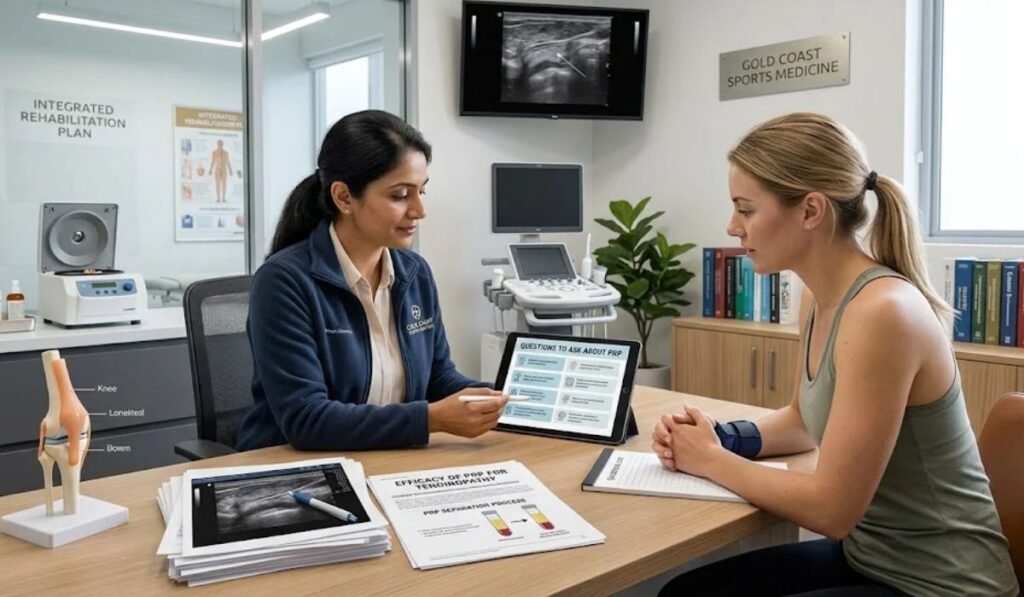

Platelet-rich plasma (PRP) injections are offered for a range of sports and musculoskeletal injuries, and the way they’re discussed online can make the decision sound far simpler than it actually is. PRP treatment has a reasonable research base for some conditions and very little for others, the process itself differs from one provider to the next, and it’s usually only one part of a longer recovery plan rather than a fix on its own.
If PRP has been offered, or it’s worth asking about, a handful of well-chosen questions tend to reveal a great deal. They help clarify whether it’s actually a sensible option for the injury in question, and they show plenty about how the person recommending it approaches the decision in the first place.
Is My Diagnosis Confirmed?
Any treatment decision rests on knowing precisely what’s actually wrong. Worth asking how the diagnosis was reached, whether it was based on examination alone or supported by imaging such as ultrasound, and whether anything else could be causing the symptoms. Pain around a tendon, for instance, can come from the tendon itself, a nearby bursa, a joint or a nerve, and each points in a genuinely different direction for treatment.
At a consultation, a doctor should take a detailed history and examine the area, and possibly scan it, before discussing whether PRP is appropriate at all. If the diagnosis is still uncertain, that’s worth clarifying before considering any injection.
Has PRP Been Studied for My Condition, and What Did It Find?
This question carries the most weight, and the answer depends heavily on the injury itself. PRP treatment has been studied more in some conditions, such as certain tendon problems and knee osteoarthritis, than in others, and even there the results are mixed. Some trials report real benefits, while others show little difference compared with alternative treatments.
Worth asking a doctor to describe the evidence for the specific condition honestly, limits included. A balanced answer will mention uncertainty somewhere in it. Anyone describing PRP as suitable for almost everything, or presenting it without touching on what the research hasn’t shown, is worth being cautious about. It can also help to ask whether the relevant studies involved people similar in age, activity level and how long the problem had been present.
How Will It Be Prepared and Injected, and Who Will Do It?
PRP is made from a sample of the patient’s own blood, spun in a centrifuge to concentrate the platelets. Preparation systems vary, and the resulting samples can differ meaningfully in platelet concentration and white blood cell content. Worth asking which type of preparation the treatment will use and why it suits the condition at hand. The laboratory detail itself doesn’t need following closely, but a clear answer suggests real thought has gone into which preparation fits the injury.
Worth finding out, too, how the injection will be guided. Many PRP injections are given under ultrasound, so the needle can be seen reaching the target tissue directly. Asking who will perform the procedure, what their training actually is, and how often they carry out this type of injection, all of that is fair ground to cover before agreeing to anything.
How Many Injections, and What Rehabilitation Follows?
Some protocols involve a single injection, while others use a short series spaced weeks apart. Worth asking how many are planned and how the decision about any further injections will actually be made.
Just as important is what happens afterwards. PRP treatment is generally used alongside a structured rehabilitation programme rather than on its own, and the exercise work that follows is often where much of the longer-term progress actually happens. Worth asking who will guide the rehabilitation, how activity will be reintroduced and how progress will be measured along the way. A plan that stops at the injection leaves out the part most likely to matter in the end.
What Are the Risks, and What Is Recovery Like?
Worth having the risks spelled out in plain language rather than glossed over. Those usually discussed include a painful flare in the days after the injection, which may limit activity for a short time, bruising where blood was taken or where the needle went in, stiffness in the treated area and, uncommonly, infection. Reactions to the injected material itself aren’t expected, since it comes from the patient’s own blood. Anyone on blood-thinning medication, or with a bleeding disorder, should mention it early rather than later.
Recovery generally means a few days of relative rest, then a graded return to loading. Worth asking how pain will be managed in that first week, whether any usual medications need adjusting, and which signs, spreading redness, heat or a fever, should prompt contact straight away rather than waiting it out.
What Are the Alternatives, and What if I Do Nothing?
PRP is rarely the only option on the table. Depending on the condition, alternatives may include a dedicated exercise programme, load modification, other injection types, bracing or, in some cases, onward referral for a surgical opinion. Worth asking how these compare for the specific situation at hand.
It’s equally fair to ask what’s likely to happen without treatment at all. Some musculoskeletal conditions improve over time with sensible management on their own, and knowing the natural course of an injury helps put any treatment properly in context. Worth asking, too, for any fees to be explained individually before deciding, follow-up appointments included.
Where to Ask These Questions
These questions apply wherever PRP is offered, not just at one clinic. Gold Coast Sports Medicine is a non-surgical sport and exercise medicine practice in Benowa on the Gold Coast, where injection decisions of any kind are made as part of a broader management plan rather than in isolation. The clinic welcomes GP referrals, and asking a GP about one can help keep care properly joined up.
A Good Clinician Welcomes Questions
Deciding on PRP treatment gets a good deal easier once the diagnosis, the evidence, the risks and the plan that follows are all genuinely understood. A good clinician will welcome these questions and answer them plainly, including when the honest answer is that the evidence is uncertain, or that another option may simply suit better.