
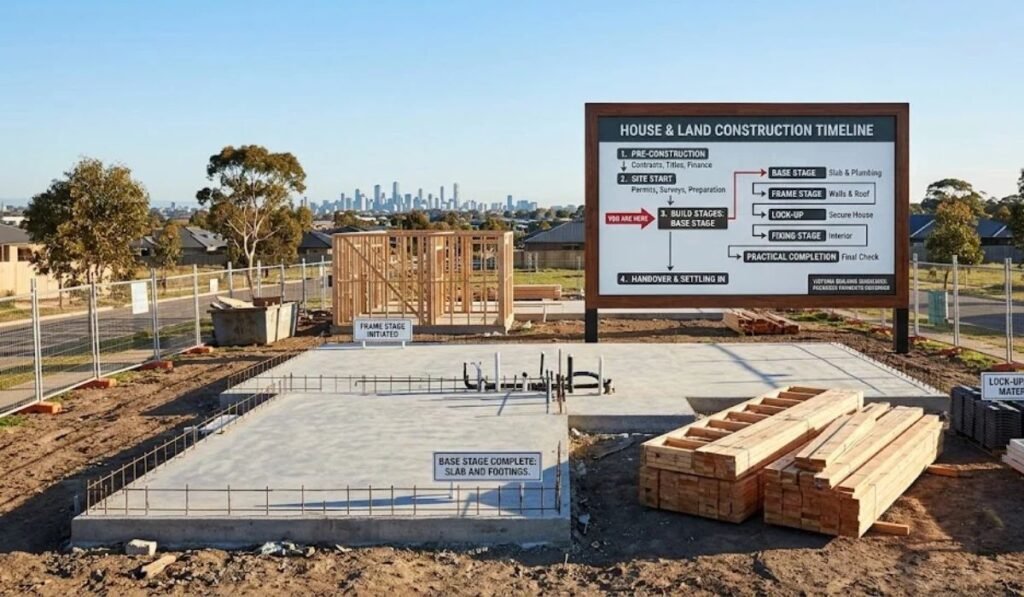

For first-time builders, the stretch between signing a contract and collecting the keys can feel like a black box. Weeks pass with little to see, then the site changes almost overnight. Knowing the order of events makes the wait easier, and it helps buyers ask the right questions at the right moments.
Most house and land packages follow a broadly similar path, even though every builder and block has its own rhythm. This guide walks through each phase from signing to settling in. Timeframes vary widely, so it’s worth treating it as a map of the sequence rather than a fixed schedule.
Before Construction: Contracts, Titles and Settlement
Behind most house and land packages sit two contracts, each with its own conditions, deposits and dates, the land contract and the building contract. Worth reading both closely, and having a conveyancer or property lawyer review them before anything’s signed.
With house and land packages in new communities, the land is often sold before its title has even been registered. Civil works like roads, drainage and services need to be finished, and the plan of subdivision registered, before titles can issue, and land settlement generally follows once they do. The builder usually can’t start until the land has settled and sits in the buyer’s name.
Finance runs alongside all of this. Construction lending works differently from a standard home loan, since funds are released in stages as the build progresses. A licensed lender or mortgage broker can explain how that applies to a given situation, and it’s worth having those conversations before either contract gets signed.
Site Start: Permits, Surveys and Preparation
Once the land has settled, the pre-construction paperwork begins properly. In many communities, the home design needs approval against the developer’s design guidelines first. A registered building surveyor then assesses the plans and issues the building permit, which is the formal green light for work to begin.
Soil testing and a site survey are usually done early, often before the build contract is even finalised, because they shape the slab design and the site costs. Once the permit’s in hand, the builder sets out the house position on the block, installs temporary fencing and prepares the ground, which can include levelling, excavation or retaining where the site calls for it.
The Build, Stage by Stage
Residential construction is generally described in five stages, and each one doubles as a payment milestone.
- Base stage. Footings and the concrete slab are completed, along with the plumbing that runs beneath it.
- Frame stage. Wall and roof frames go up, and the shape of the home becomes clear for the first time.
- Lock-up stage. External walls, roof covering, windows and external doors go in, so the home can finally be secured.
- Fixing stage. Plasterboard, internal doors, skirting, cabinetry and fittings are installed, and the interior starts looking genuinely finished.
- Practical completion. The home is complete in line with the contract and plans, apart from any minor defects that don’t stop it being used.
At the end of each stage, the builder issues a progress claim, and the buyer or their lender pays it. Visiting the site between stages is reasonable enough, but it’s an active construction zone, so it’s worth arranging visits through the builder’s site supervisor rather than turning up unannounced.
How Deposits and Progress Payments Are Governed in Victoria
In Victoria, deposits and progress payments under a domestic building contract, including the build side of house and land packages, are governed by the Domestic Building Contracts Act 1995. The Act limits how much a builder can take as a deposit and sets out the stages at which payments can be claimed, so buyers aren’t asked to pay ahead of the work actually completed. Consumer Affairs Victoria publishes plain-language guidance on how these rules work in practice. Buyers elsewhere should check the equivalent rules in their own state, and confirm the builder is registered and holds any required insurance.
Why Timelines Move
Delays are common in residential building, and most have fairly ordinary causes. Wet weather can stall slab and site work. Variations requested after signing add time as well as cost. Trades and materials aren’t always available when the schedule needs them, and approvals can take longer than expected.
None of this means a build is going badly. It does mean it’s worth asking for the estimated construction timeframe in writing, understanding what the contract says about extensions of time, and keeping a note of any variations approved along the way.
Handover and Settling In
As practical completion approaches, the builder will invite the buyer to a pre-handover inspection. This is the moment to walk every room with a checklist and note anything unfinished or faulty. Many buyers bring in an independent building inspector for this walk-through, and often at earlier stages too, since a trained eye tends to pick up issues a first-time builder might miss entirely. Agreed defects should be listed in writing before the final payment is made and the keys change hands.
Handover isn’t quite the finish line for most house and land packages, either. Driveways, fencing, landscaping and letterboxes are often the owner’s own responsibility, and design guidelines in new communities may set expectations for when front gardens need completing. Planning those jobs early tends to turn the first few months in a new home into settling in, rather than scrambling to catch up.
Asking About the Process in a New Community
Every community handles the sequence a little differently, so it’s worth asking directly rather than assuming. A sales team can usually explain how land settlement and the start of building are expected to fit together for a current release, and that conversation tends to be far more useful before signing than after.
Patience With a Plan
Building a new home is a long project, but it doesn’t need to stay a mysterious one. Understanding the stages, the payment rules and the usual causes of delay puts buyers far more in control of the process than they might expect going in. Whichever builder gets chosen, keeping the paperwork organised, asking questions early and getting key answers in writing tends to make every stage feel a good deal more familiar than the one before it.