
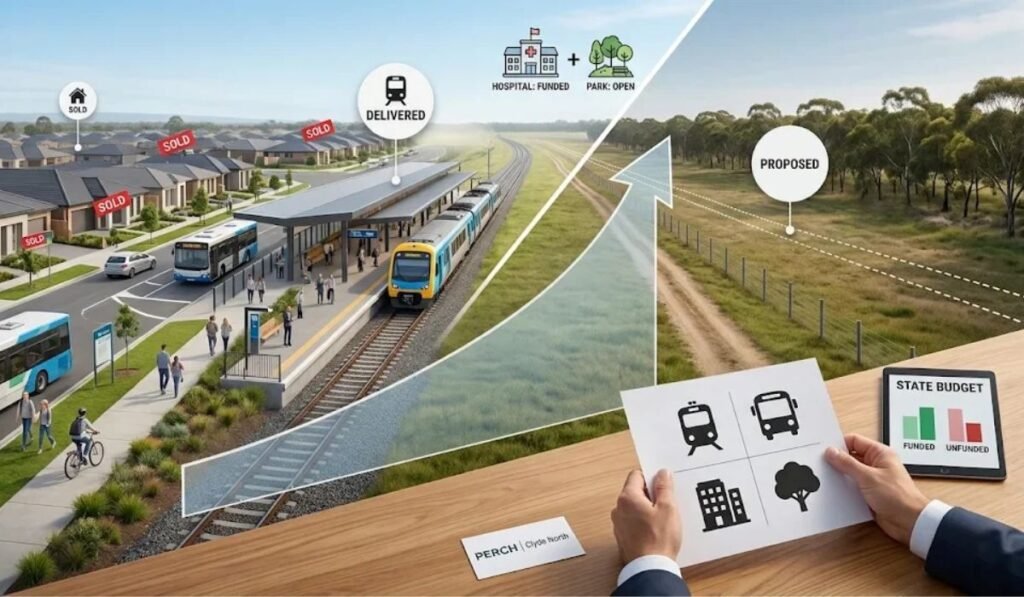

Transport infrastructure has a measurable relationship with residential property values, and it’s one of the few things in property analysis where the mechanism is genuinely well understood: accessibility has a price, and buyers pay it without much hesitation.
Where it gets complicated is timing. A station opening next year and a station that’s been discussed for two decades tend to get treated identically in a great deal of property marketing, and they really shouldn’t be.
Why Transport Moves Prices
The underlying logic is straightforward enough. Housing markets price the cost of getting to work, school and services, in money, and more importantly in time. Reduce that cost and the pool of people for whom a location is viable widens accordingly.
The effect is strongest for rail, because rail changes the commute in a way road upgrades generally don’t. A road improvement reduces travel time right up until traffic grows to fill it again. A station creates a fixed, congestion-independent journey, and that reliability is exactly what people are paying for.
The effect also concentrates sharply with distance. Walkability to a station is the threshold that actually matters here. A station four kilometres away that requires driving and competing for a car park delivers a fraction of the benefit of one that’s genuinely walkable.
Announced, Funded, Under Construction, Delivered
This is the distinction that does most of the real work, and it’s the one property marketing most often blurs.
- Announced or advocated. A political commitment, a council priority, or a line on a long-term strategy document. No money attached. Historically, a substantial proportion of these don’t proceed on anything like the timeframe implied.
- Funded. Money allocated in a budget. Considerably more likely, though budgets change with governments.
- Under construction. Very likely to be delivered, with timing the main remaining variable.
- Delivered and operating. Certain, and already reflected in prices by the time anyone’s reading about it.
Buyers pay a premium for delivered infrastructure. The real opportunity, and the real risk, sits in the gap between funded and delivered, not in the gap between announced and funded, which is where most of the failures actually happen.
The practical rule worth keeping in mind: buy on what exists, and treat anything unfunded as upside that hasn’t been paid for yet.
A Live Example Worth Understanding
Melbourne’s southeast provides a useful case study, mostly because the situation is unusually well documented.
The City of Casey has advocated for years for the Clyde Rail Link, a duplicated extension of the Cranbourne line with proposed new stations at Cranbourne, Cranbourne East, Casey Fields and Clyde, plus an expanded bus interchange and train stabling. The council is seeking funding from both state and federal governments and has made it a flagship item in its advocacy campaigning. The council’s own project page sets out the scope in detail.
The case for it is genuinely strong. Clyde and Clyde North have grown rapidly, residents currently travel to Cranbourne station, and parking there is a well-documented constraint.
It’s also, as at August 2026, unfunded. Infrastructure Victoria’s long-term plan released in late 2025 listed the extension as a future option, nothing more concrete than that. Similar commitments were made ahead of the 2018 and 2022 state elections and didn’t proceed either time.
Meanwhile, more modest transport improvements have actually been delivered in the same area: bus route extensions into Clyde and Clyde North, and a substantial allocation to Casey bus network upgrades in the 2026–27 Victorian Budget. Less headline-grabbing, but genuinely operating right now.
The lesson here isn’t that Clyde North is a poor place to buy. The market there is deep and active for reasons largely unrelated to rail. It’s that a buyer should be pricing it on the buses that run today rather than the station that might be funded at some future election.
Infrastructure Beyond Transport
Transport gets most of the attention, but several other categories have comparable, or even larger, effects.
- Hospitals. A major hospital is among the most powerful anchors available, because it brings sustained skilled employment as well as services, and it draws allied health and medical businesses into the surrounding area with it.
- Schools. The most consistent influence on family housing demand, and unusually durable, since each new cohort of families weighs catchments the same way the last one did.
- Employment precincts. Logistics, industrial and commercial developments that create local jobs reduce dependence on commuting entirely, which is a more complete solution than simply improving the commute itself.
- Retail and town centres. Meaningful when they represent a genuine step up in amenity, less so when they just add to what already exists. Planned town centres are worth the same funded-versus-announced test as anything else, and some communities, such as Perch’s own neighbourhood planning, set out what’s actually committed within the masterplan itself rather than leaving it vague.
The Mistakes Buyers Repeatedly Make
- Treating a plan as a commitment. Structure plans and strategy documents indicate intent over decades. They are not schedules, whatever the renders suggest.
- Ignoring who is delivering it. Developer obligations that appear in an approved development plan are considerably more reliable than state projects competing against every other state project for the same budget.
- Paying the premium before delivery. If a location is already priced as though the station exists, the upside has already been captured by the seller, not the buyer.
- Underweighting what already works. A frequent bus route, an operating school and a supermarket within walking distance affect daily life more than a rail line still a decade away.
- Assuming infrastructure only pushes prices up. A road widening, a rail corridor or a freight route can also affect amenity for the properties sitting immediately adjacent to it.
How to Actually Check
The information is public, and it genuinely takes about an hour to gather.
State budget papers show what’s funded and at what level. Infrastructure body advice, Infrastructure Victoria and its equivalents elsewhere, shows what’s recommended and with what priority attached. Council advocacy pages, usefully, show what a local government wants but doesn’t yet have, and the presence of an active advocacy campaign is itself a reliable signal that something isn’t funded. Approved development plans show what a developer is contractually obliged to deliver, not just promising to. Transport authority planning documents show route and service changes as they’re actually confirmed.
Then it’s worth asking the agent or developer one direct question, and listening carefully to the answer: is this funded, and by whom? A precise answer is informative in itself. A vague one is just as informative.
The Reasonable Position
Infrastructure genuinely does drive value, which is exactly why it’s used so heavily in marketing, and exactly why buyers should assess it carefully rather than dismiss it out of hand.
Buy in a location that works today on the infrastructure that exists today. Where credible funded projects are underway, it’s worth understanding that some of that benefit is already baked into the price. Where projects are merely advocated, they’re worth enjoying if they eventually arrive, but not worth building a position on in the meantime.
Growth corridors across Melbourne, established communities such as Perch in Clyde North included, vary enormously on this measure. The estates worth a closer look are generally the ones willing to say plainly which items on the map are actually built, and which are still just hoped for.